
The first few minutes after a collision can shape your safety, your insurance record and what happens to your vehicle next. Knowing what to do after a car accident in Calgary helps you replace rushed decisions with a calm, practical sequence.
Start with Safety, Not Vehicle Damage
Stop immediately and check whether anyone is injured. Call 911 when someone is seriously hurt, anyone is in immediate danger or you suspect an offence such as impaired driving. Do not move an injured person unless emergency personnel direct you to do so, and avoid standing between vehicles or behind a damaged vehicle while inspecting it. (Calgary Police Service)
When there are no injuries and the vehicles can be driven safely, move them out of active traffic before exchanging information. On busy Calgary routes such as Deerfoot Trail, Stoney Trail or Glenmore Trail, remain alert to traffic and follow police or emergency-worker directions. If a vehicle cannot be moved, turn on the hazard lights and wait in a safer location when conditions permit. (Calgary Police Service)
Know When a Calgary Collision Must Be Reported
A Calgary collision must be reported when anyone is injured, the incident is a hit and run or the combined property damage reaches the $5,000 reporting threshold. Alberta confirmed that the $5,000 threshold remains unchanged for 2026. Estimating damage at the roadside can be difficult, so consider possible damage to bumpers, sensors, lights, wheels and suspension rather than looking only at visible dents. (Calgary Police Service)
Choose the Correct Reporting Method
Call 911 or Calgary Police Service at 403-266-1234 when someone is injured or a vehicle is not drivable. Non-injury collisions involving drivable vehicles can be reported at a district office. Bring your driver’s licence, vehicle registration, proof of insurance and the information collected from the other driver. (Calgary Police Service)
Alberta’s Report My Collision system may be available for certain non-injury incidents, including supported single-vehicle collisions, specific two-vehicle collision types and some parked-vehicle hit-and-run cases. Not every collision qualifies for online reporting, so follow the eligibility instructions in the official system. (Calgary Police Service)
Build a Complete Collision Record
Stress can make important details easy to forget. Exchange the following information with every involved driver:
- Full name and contact details
- Driver’s licence information
- Vehicle licence plate
- Vehicle make, model and colour
- Registration details
- Insurance company and policy information
- Registered owner’s details when different from the driver
Take wide photos showing the overall scene, traffic signs, lane positions and road conditions. Then photograph damage to every vehicle from several angles. Record the date, time, exact location, direction of travel and a brief account of what happened while the details are fresh. Collect witness names and contact information when available.
Do not admit fault, promise payment or agree to settle privately at the scene. Alberta advises drivers to provide accurate facts and allow insurers and the appropriate authorities to assess responsibility. Police charges do not automatically decide insurance liability. (Alberta.ca)
Protect Your Choices When the Vehicle Cannot Be Driven
A non-drivable vehicle after a crash must be removed from the roadway. Before authorizing the move, decide where it should go whenever the situation allows. Practical destinations may include a body shop, mechanic, your home, an insurer-approved facility or secure storage while you confirm the next step.
Under Alberta’s Vehicle Towing and Storage Regulation, a consumer-directed tow generally requires the owner’s consent and a written estimate before the vehicle is taken. When mileage is charged, the operator must normally use the most direct route, and the vehicle can only be taken to a location approved by the owner. Different requirements can apply when the tow is directed by law enforcement or another government authority. (Alberta.ca)
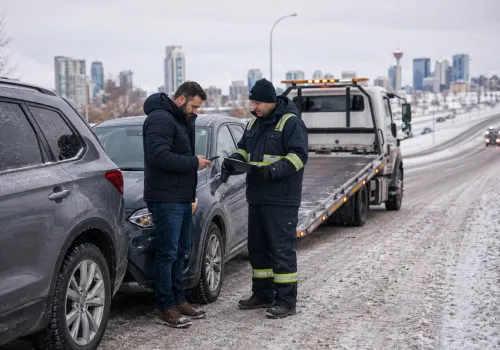
Ask for the destination to be confirmed clearly. Also ask whether storage is expected, where the vehicle will be stored, what the storage rate is and how access or release works. Keep the estimate, invoice and any receipt with your collision records.
Give the Operator Accurate Vehicle Details
Collision damage can affect which towing method is appropriate. When requesting help, provide:
- Your exact location or a dropped map pin
- Your direction of travel and nearest exit
- Vehicle make, model and approximate size
- Whether the vehicle starts, rolls and steers
- Visible wheel, tire or suspension damage
- Whether fluids are leaking
- Whether the keys are available
- The number of people waiting
- Your requested destination
- Photos showing the vehicle and surrounding access
A damaged vehicle may need a rollback flatbed, wheel-lift equipment, dollies, winching or controlled recovery. Grewal’s Towing Ltd. operates flatbed and wrecker equipment and assesses the vehicle’s condition, access and safety requirements before selecting a suitable method.
Contact Your Insurer Promptly
Notify your insurer as soon as possible, regardless of who appears to be at fault. Provide the collision details, police file number when applicable, photographs and information about injuries or property damage. Ask what your policy covers, whether an inspection is required and whether the insurer has instructions concerning repairs or storage. (Calgary Police Service)
You retain the right to choose service providers, including a repair shop and towing company. Direct insurance billing for accident-related transportation may be available through Grewal’s Towing Ltd. depending on the policy, coverage and circumstances. When direct billing does not apply, a customer who pays personally can receive a receipt to support an insurance claim. Coverage and reimbursement should always be confirmed with the insurer. (Alberta.ca)
Keep a Simple Post-Collision Checklist
Before considering the immediate process complete, confirm that you have:
- Reached a safe location
- Contacted emergency services when necessary
- Exchanged driver and insurance information
- Photographed the scene and damage
- Recorded witness details
- Reported the collision when required
- Confirmed the vehicle’s destination
- Kept the written estimate and invoice
- Contacted your insurer
- Saved all file numbers, receipts and messages
Get Clear Help with the Vehicle’s Next Move
A collision is easier to manage when each decision is handled in the right order: safety first, documentation second, reporting next, followed by a clear plan for the vehicle.
Grewal’s Towing Ltd. moves damaged and non-driving light- and medium-duty vehicles from collision scenes to a customer-selected accessible destination, including a home, mechanic or body shop. Accident-vehicle storage may also be available when appropriate.
Call 587-899-0095 for 24/7 phone support, current truck availability and a realistic estimated arrival time. Overnight towing depends on driver and truck availability.